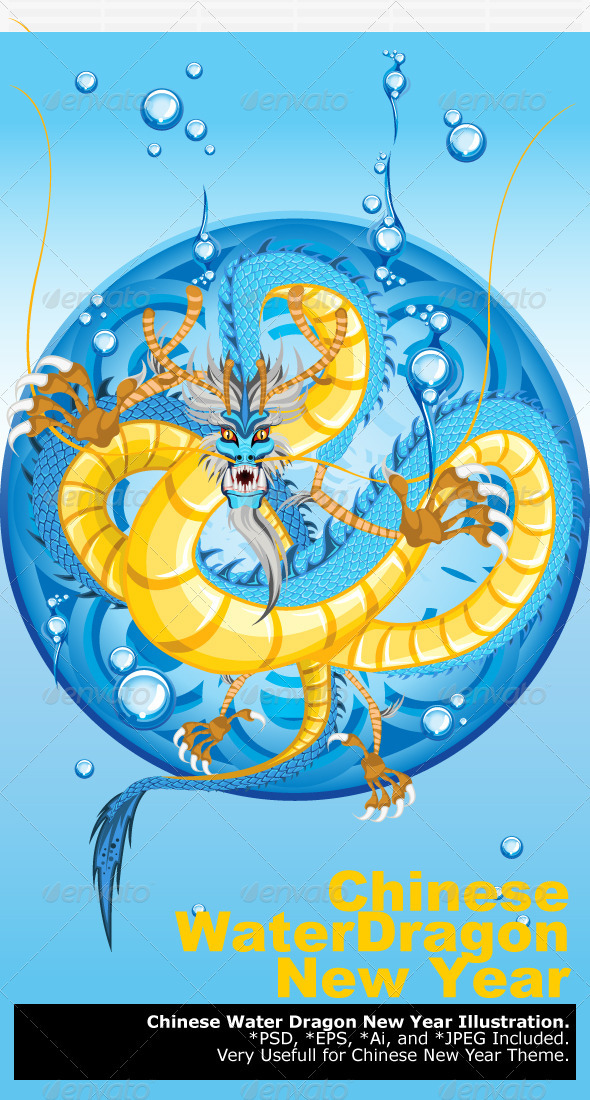
Water Dragon Chinese New Year. Water, metal, wood, earth and fire types of dragon. Each dragon year also has one of five elements associated with it.
Chinese Water Dragon New Year GraphicRiver from graphicriver.net New Year Celebrations Around the World
The New Year marks the beginning of the new calendar. It marks the day when the year's count increases by one. There are many cultures that observe the New Year, but the Gregorian calendar is the most well-known. Continue reading to discover more about the customs of this holiday. Enjoy some delicious food and drink!
Respect
Different cultures have their own customs for celebrating the new year. Some people mark it with religious ceremonies. Buddhists and Hindus present gifts to their elders. Chinese offer oblations of gratitude to their gods. These festivals also provide a chance to exchange and receive good wishes from your friends and family.
The origins of New Year's Day are traced to the 7th century, when pagans commemorated the Annunciation. Religious officials were unhappy with the custom of celebration of the New Year the same day as Jesus was born. The custom of giving gifts first came into use in Flanders and Holland around the 7th century. It is believed that the Gregorian calendar influenced the practice of celebrating the beginning of the year. Julius Caesar also named this month Janus as the Roman god of beginnings. The god was known as a dual-faced god and was able to look into the past and the future.
Today, New Year's Day can be celebrated in many countries on the 1st of January. The day that begins the year is January 1 according to the Gregorian Calendar. Other calendars, such as the Julian calendar, start the year on a different date. However, many cultures recognize the significance of celebrating the New Year and the new beginning that it brings.
Traditions
There are many different traditions to celebrate the new Year. The celebrations are held in different families, cultures and cities across the world. There are a variety of ways you can start your year.
New Year’s Eve celebrations typically take place on December 31. They last until early in January 1. A lot of people love eating foods that symbolize good luck. For example, grapes and legumes are believed to bring prosperity to people who eat them. The same way the lighting of fireworks to welcome the new year in America.
Another tradition is consumption of cabbage on New Years Day. It is believed to bring prosperity and wealth into the following year. In New York City, the giant ball dropping in Times Square is a tradition that's been a regular part of New Year celebrations since 1907. The massive sphere weighs 12,000lbs and weighs 12,000lbs.
A second tradition, known as "podariko," is also prevalent in the Mediterranean. It means "good feet." This custom is rooted in the belief that pomegranates are being lucky and a symbol of fertility. The people also hang pomegranates on their doors before the holidays. The lucky ones will walk into the house with their right foot.
Religion
Most countries mark the beginning of the new year by observing the holy holidays. In Japan, for example the people offer presents to Buddhist monks on Rosh Hashana. China is a celebration of the New Year by offering offerings to gods of wealth, life as well as ancestral spirits. National holidays are celebrated in a few areas of the world to mark the beginning of a new year.
Orthodox Christians in the UK celebration of the new year is marked by liturgies. Many also attend blessings from the famous Orthodox Christian figure. Many celebrate the holiday by hosting parties and sharing meals. A lot of people light fireworks to mark the start of a new year. Whatever the form of celebration, it's an opportunity to celebrate the start of the year.
Food
The New Year's Eve meals are filled with festive, traditional food. Traditional rich and lavish food options could include Champagne or oysters. Other traditional options include foie gras, or Smoked salmon. Although the main dish is usually a bird dish like turkey, goose, or Cornish hen, there are other options. Another popular choice for a festive dinner is lobster, venison , and scallops.
Although it's not necessary to incorporate them into your celebration in any culture, many people consider them as part of the New Year. In several countries, grapes are considered to be lucky, and some people take a glass of grapes for each bell chime on the day that ends the year. This is a symbol of how to bring good fortune to your new year.
In many parts Asia Fish is often associated with wealth, prosperity and abundance. Japan is one instance of this. Eating herring on New Year's Day signifies that the year ahead will bring prosperity. Additionally, in Scandinavia, pickled herring is associated with prosperity. Swedes also believe that eating large amounts of fish will bring good fortune.
Holidays
Different cultures celebrate holidays during the new year with special foods and festivities. Many countries celebrate the New Year with eating symbolic foods like cabbage, believed to bring prosperity. Black-eyed peas are a symbol of good fortune and luck in the United States. Asian traditions also celebrate holidays with special foods. Many elaborate dishes are made of ingredients with symbolic names or images.
The time of the year for holidays varies from one to four days. The New Year's Day begins on January 1. The New Year will be celebrated on the Saturday of 2022. Therefore, the period of celebration will be 3.25 days.
Apart from the four bank holidays to celebrate the New Year there are many other bank holidays. A four-day extended bank holiday will be observed in 2022 to mark the Queen's Platinum Jubilee celebration. On the day of Queen Elizabeth's birthday on the 28th of December, people are allowed up to three days off
The time of year's close is a time of joy. People can let go the past and focus on a brighter future. Students are able to have a break from school and this is a great time for family time.
Date
In many countries in the world, the New Year starts on January 1. People celebrate the New Year by singing, dancing and exchanging gifts. It is the longest-running holiday in the world. Its roots are from Babylon. The festival was initially celebrated for 11 days in spring. The date of the festival was changed to this year to celebrate Jesus Christ's birth.
The New Year's day has experienced a slight shift throughout the world since the introduction of the Gregorian Calendar in 1582. In 1582 the pope Gregory XIII changed the calendar, moving the New Year to the first day of January to keep the balance between the seasons and the calendar. After many years, the New Year's date was finally fixed on January 1st.
A variety of people also observe New Year. The Chinese are celebrating Lunar New Year, February 11th and 26th, and the Hindus celebrate Hindu New Year, February 20th. The lunar and solar cycles are the foundation of the Hindu panchanga (also called the Hindu panchanga). The Hindu calendar is dependent on the days and seasons and began in the year 57 BC. The Hindu Year is a leap-year and therefore, its date may change depending on leap year.
Origin
The origin of the year of the pig is not entirely evident. Some people believe it originated in ancient China. Chinese mythology states that the mythical creature was a mythological animal that had the head and bodies of an ox, as well as the body and body of a lion. It was believed to have emerged during New Year’s Eve. It was afraid to fire, noise or red. Chinese tradition celebrates the start of the new year by hanging red canvases.
The Roman calendar began with March 1 and included 10 months. Each one was a continuous 304 days. In this early calendar the moons of the ninth and twelfth were first called the seventh and the tenth. Julius Caesar, the Roman ruler, developed an solar calendar. This calendar is very like the one we have today.
Today there are many Asian cultures celebrate the new year by following the lunar calendar. This ancient calendar is utilized in countries such as China and Korea. The year starts after the first new Moon following the solstice of winter.
The dragon is a lucky sign, the fifth of the 12 animals in the chinese zodiac. The year of the water dragon begins on 23rd january 2012. Because of their outstanding achievements, retired water zodiac dragons will have a higher pension.
Years Of The Water Dragon.
2012 is chinese zodiac dragon year, and it belongs to the water year based on chinese five elements, so people born in 2012 are water dragon. Water, metal, wood, earth and fire types of dragon. The lunar new year 2572 itself starts from.
The Dragon Is The Fifth Of The Twelve Chinese Zodiac Animals What Year Is The Water Dragon?
Dragons in the year of the rabbit (2023) the year of 2023 won’t be easy for the dragon, as it’s a year of “fan tai sui” for them. Gold (metal), wood, water, fire, or earth. The animal cycle includes the rat,.
People Born In The Year Of 1952 (Jan.
1928, 1940, 1952, 1964, 1976, 1988, 2000, 2012. Each dragon year also has one of five elements associated with it. According to chinese zodiac, 1952 is the year of chinese zodiac dragon, and on the basis of chinese five elements, the year.
09, 2013) Which Is Ren Chen Year Are Members Of The Water.
Try now to find your own sign and luck prediction! Those born in january or february should take particular note of when chinese new year falls to confirm their birth sign. The dragon is a lucky sign, the fifth of the 12 animals in the chinese zodiac.
The Year 2021 Will Be A Pivotal Year For The Water Chinese Dragon.
The dragon is the fifth of the twelve chinese zodiac animals what year is the water dragon? In 2023, the dragon will be less reckless than usual. You’re a wood dragon if you’re born in 1964 or 2024 (on chinese new year 2024, the next generation of wood dragons will be born).
Share :
Post a Comment
for "Water Dragon Chinese New Year"
Post a Comment for "Water Dragon Chinese New Year"